- Coralie's Newsletter
- Posts
- Newsletter #67: the Catalog API, my own health dashboard, and the Pacific Northwest
Newsletter #67: the Catalog API, my own health dashboard, and the Pacific Northwest

Coralie Delpha
March 14, 2026
Hi there,
I hope you’re feeling good. Long time no see!
If you've been subscribed for a while, you know I've always loved building things. Over the years I've created a personal movie blog, a concert-rating web app, two public Shopify apps, and even the occasional physical project (like the wooden stool I shared in edition 5).
But in the past few months, something has changed.
I've been deep into Claude Code, and it has completely pushed the boundaries of what's possible for me.
All the ideas I used to keep for “later” are now getting built - often several at a time, with multiple terminals running side by side. Sometimes they’re even building while I sleep, and I get this urge to run to my computer as soon as I wake up. What a time to be alive!
In today's edition, we're discussing Shopify's Catalog API, my personal health dashboard, and the Pacific Northwest.
Let's dive in.
Work
Shopify is making big moves in agentic commerce, and one development I find particularly exciting is the Catalog API.
The Catalog API provides access to product data across all eligible Shopify merchants, enabling agentic commerce applications to search, discover, and retrieve detailed product information to render product detail pages.
I’m incredibly eager to see what developers are starting to build with it.
Gil Greenberg - founder of Checkout Blocks and now a Staff Product Manager at Shopify following its acquisition - recently shared two experiments on Twitter that caught my attention.
In January, Gil built a mobile app using the Catalog API, GPT-5, Replit, and Claude Code. The concept is simple: point your phone’s camera at a product, and the app identifies it and gives you a link to buy it.
Behind the scenes, the app sends the image to GPT-5-mini to extract product tags. Those tags are then used by GPT-4o-mini to generate a search query, which is sent to the Catalog API. Just like that, in a two-hour build, your camera becomes a shopping search bar. You can see more in the demo in his tweet.
A month later, Gil pushed the idea even further.
As shown in the screenshot below, Gil connected his OpenClaw bot directly to the Catalog API for image search. This time, the integration took just 60 seconds using codex-5.1-mini. Gil can now send a picture to his OpenClaw bot, type “Find me this product”, and instantly receive a link to buy it.
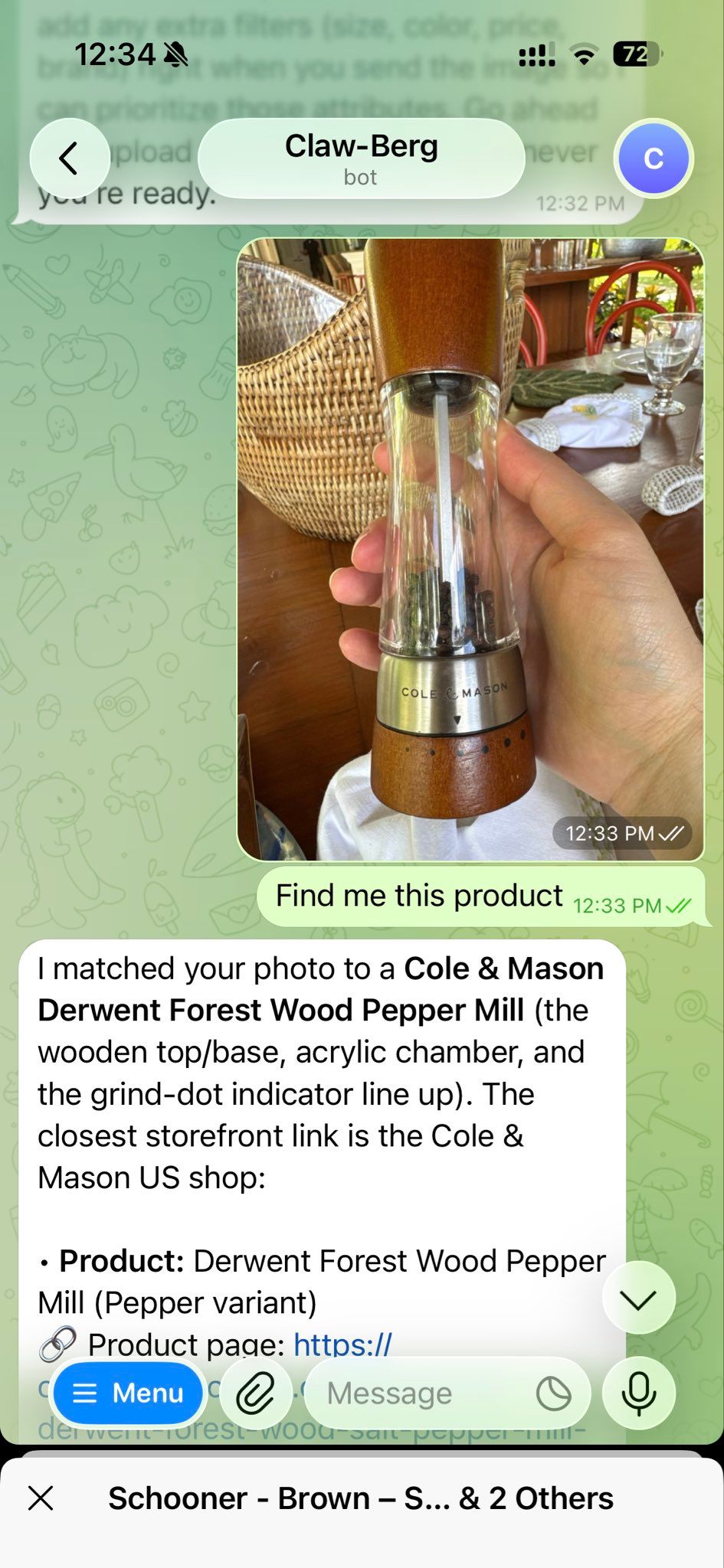
Credit: Gil Greenberg
The mobile app from a month earlier already feels like old news. Why even bother building an app for this use case?
Things are evolving incredibly fast.
The barrier to building product discovery experiences has essentially dropped to zero. And because the Catalog API is publicly available, anyone can experiment with entirely new ways of discovering and buying products.
We're probably only scratching the surface.
Inspire
Last week, I caught one of those mega colds making the rounds: the kind that knocks you flat, plugs your ears, and makes you sleep like you haven't slept in ten years. Lying on the couch staring at the ceiling, I started thinking about my health. And something clicked.
I have years of health data sitting in a folder on my laptop: blood tests, prescriptions, MRI reports, specialist letters, invoices. I've been saving everything since my doctor discovered my iron levels were incredibly low when I was in high school. Since then, regular blood tests became a habit, and the folder kept growing.
But I wasn't doing anything with it. The data just sat there.
I had been using Claude Code daily, and I thought: why not build my own health dashboard? I gave Claude the folder, described what I wanted, and less than an hour later I had a full dashboard running locally on my laptop: biomarkers over time, prescriptions, conditions, costs, and later even data from my Garmin watch for sleep and activity.
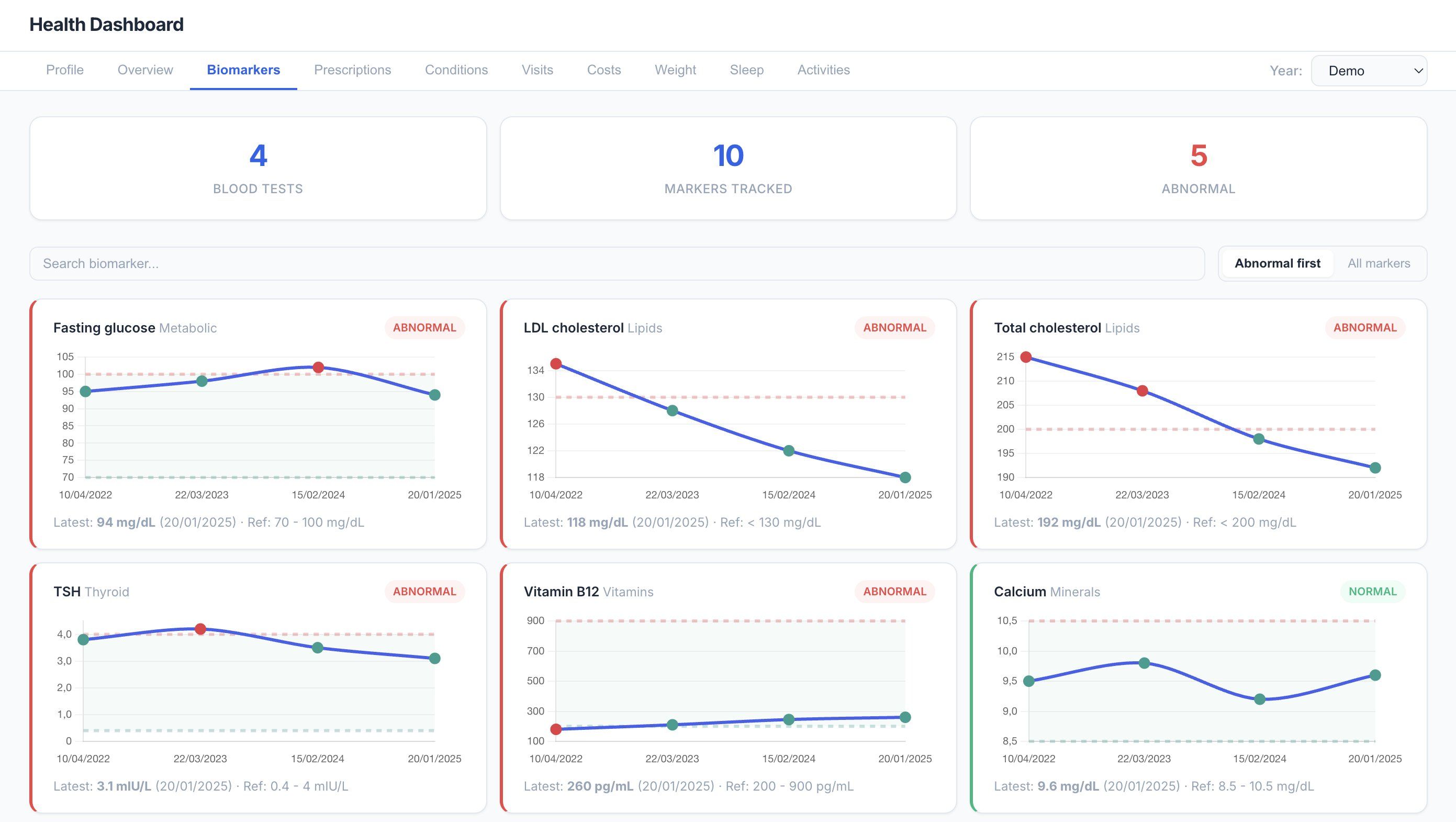
Biomarkers tab with dummy data for demo purposes
What I find genuinely useful isn't any single data point. It's the longitudinal view. Seeing my biomarkers evolve over the years, how my sleep holds up across seasons, what I actually spend on healthcare by specialty. So many questions get answered by this simple view.
I published a full article about the process: from the origin story to the technical details. I’d love your feedback on it!
Explore
I started 2026 in the Pacific Northwest, near Portland, Oregon.
One afternoon, my partner and I were hiking on Mount Rainier. At some point during the ascent, we stopped and looked around. Nothing but snowy mountains in every direction. No sound. No one. Just the feeling of being completely alone on earth. I stood there for a while.
The Pacific Northwest is one of the most beautiful places I've visited. The landscapes are massive, raw, and quiet in a way that makes you forget everything else exists.
In the evenings, we'd make a fire, grill marshmallows, and watch the sky turn dark above the trees. Not a bad way to start the year.
I’m ready for 2026!

Thank you, from the bottom of my heart, for reading this edition until the end.
I'll talk to you soon.
Take good care of yourself.
Coralie
Reply